Graphic Overlays are typically bonded to equipment housings, Control Panels, or other mounting surfaces with Pressure-Sensitive Adhesive (PSA). The adhesive must provide sufficient bond strength and also match substrates such as Metal, PC, Acrylic, PP, and Powder Coating. In this article, iTrustFab covers common Graphic Overlay adhesive constructions, 3M Adhesives, and selection methods for different application conditions.
1. Functions of Graphic Overlay Adhesive
The primary function of Graphic Overlay adhesive is to secure the panel in the specified position and maintain long-term adhesion around the edges and openings.
1) Securing the Overlay to the Equipment Surface
The backing uses Pressure-Sensitive Adhesive to bond with the equipment surface. Installation requires no additional heating or liquid adhesive. Application pressure brings the Adhesive into full contact with the mounting surface.
2) Preventing Edge Lifting
Corners and places around Cutouts are more susceptible to localized failure of adhesive. These conditions require the adhesive to have adequate Peel Adhesion and Shear Strength for long-term use so as to avoid Edge Lifting.
2. Common Graphic Overlay Adhesive Types
Typical Graphic Overlay adhesive constructions are Adhesive Transfer Tape, Double-Coated Tape and Foam Tape.
1) Adhesive Transfer Tape
Adhesive Transfer Tape (also known as carrierless adhesive film) is usually made of Pressure-Sensitive Adhesive and a Release Liner. Its thin profile makes it a common adhesive construction for standard Graphic Overlays on smooth surfaces like Metal, PC, ABS and others.
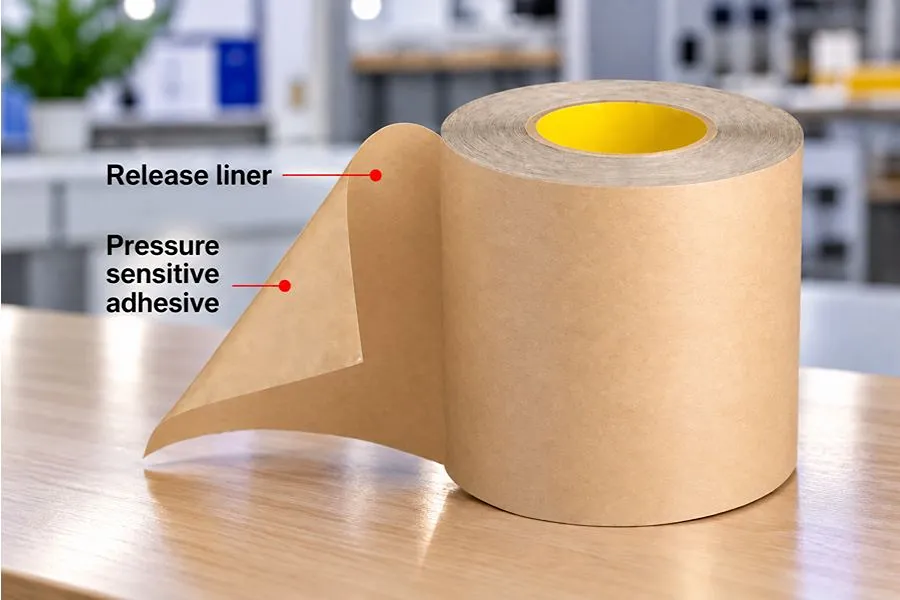
Adhesive Transfer Tape
2) Double-Coated Tape
Double-Coated Tape is made with PET, a type of tissue or other material as the Carrier, and Adhesive on both sides. When compared to Transfer Tape, it offers a more stable construction and is appropriate for Graphic Overlays that are dimensionally stable, processing speed is a critical factor or the appropriate lamination structure.
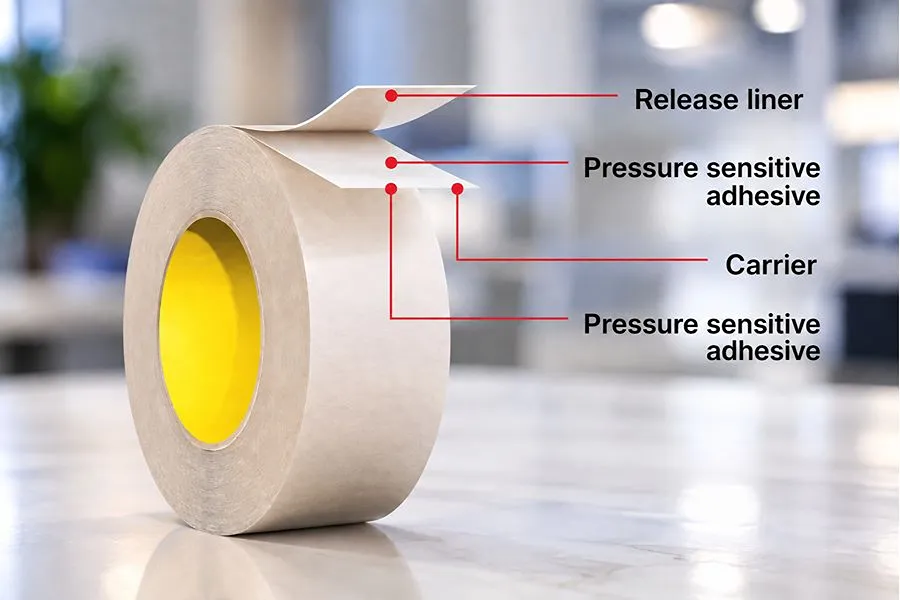
Double-Coated Tape
3) Foam Tape
Foam Tape is a thicker adhesive construction that has Foam as the Carrier and Adhesive on both sides. The Foam offers compressibility to accommodate surface height differences, texture or gaps that may be noticeable when mounting onto surfaces where standard thin adhesive will not fully bond.
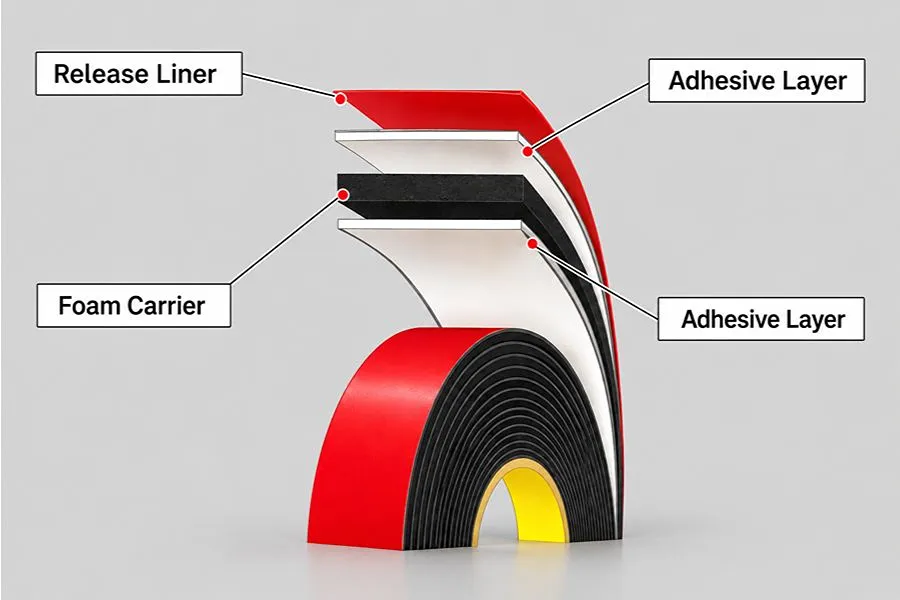
Foam Tape
3. Common 3M Adhesives for Graphic Overlays
Common 3M adhesives for Graphic Overlays include 467MP, 468MP, and the 300LSE series. These products differ in Adhesive Series, adhesive thickness, and bonding characteristics.
1) 3M 467MP
3M 467MP is an Adhesive Transfer Tape with an adhesive thickness of about 0.058 mm and an Adhesive (200MP) used is Acrylic Adhesive. It has a relatively thin bonding layer, but has strong bonding strength and is also resistant to heat, moisture and solvents.
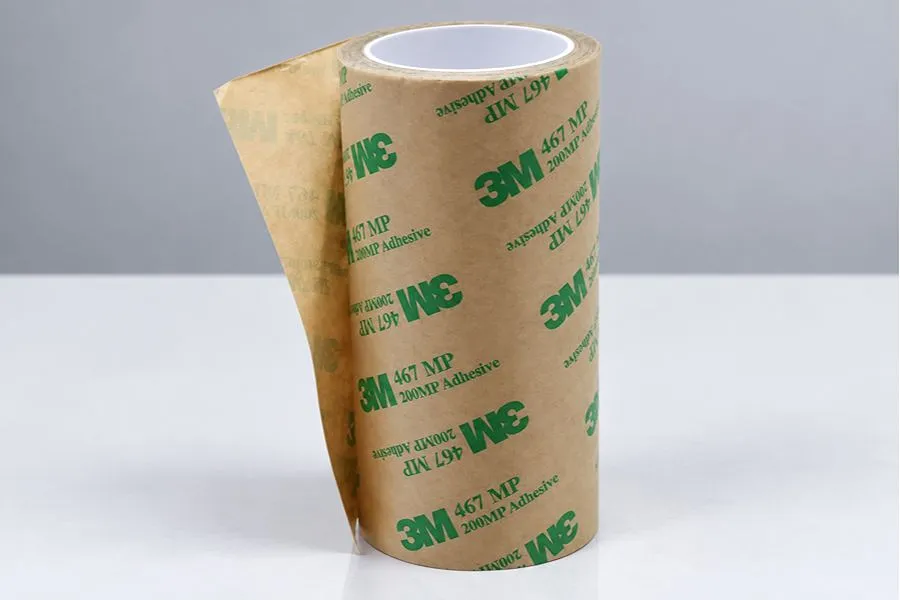
3M 467MP
2) 3M 468MP
3M 468MP also uses 200MP Acrylic Adhesive, with an adhesive thickness of approximately 0.13 mm. It uses the same Adhesive System as 467MP but has a thicker adhesive layer, providing better Wet-Out and accommodating a certain degree of surface texture and unevenness.
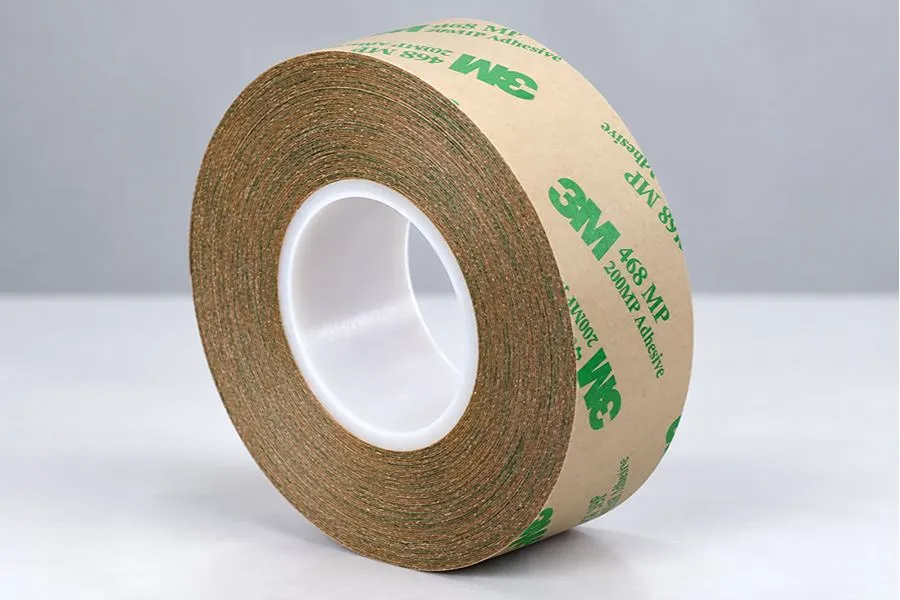
3M 468MP
3) 3M 300LSE Series
3M 300LSE is an Acrylic Adhesive series developed for Low Surface Energy (LSE) materials. It provides good adhesion to low-surface-energy substrates, together with good moisture resistance, chemical resistance, and environmental stability.
Common 300LSE Transfer Tapes for Graphic Overlays include 9471LE and 9472LE. Both use the same 300LSE Adhesive and mainly differ in adhesive thickness: 9471LE is approximately 0.058 mm, while 9472LE is approximately 0.13 mm. 9471LE has a thinner adhesive layer, while the thicker 9472LE provides better Wet-Out.
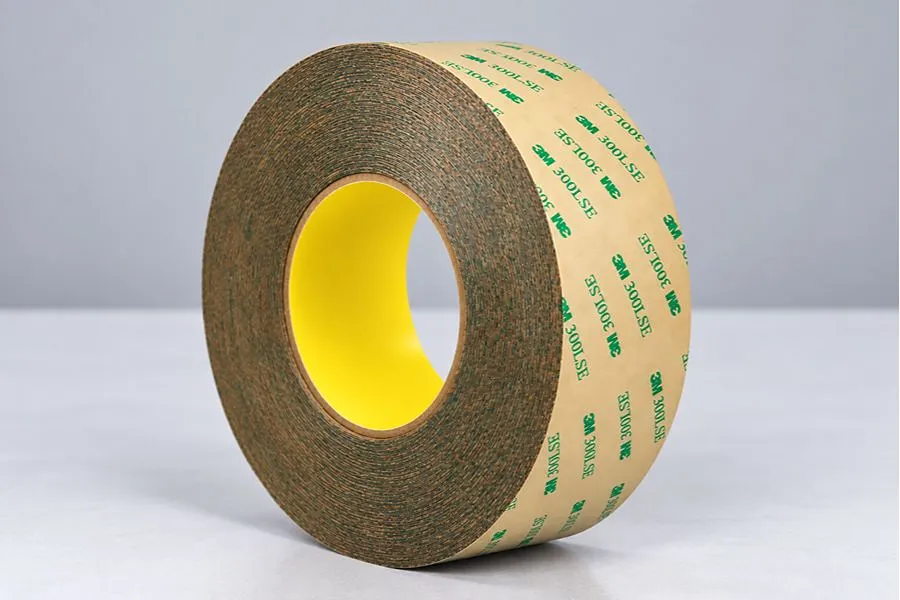
3M 300LSE
4) Other 3M Adhesive Systems for Special Applications
When standard 467MP, 468MP, or 300LSE products cannot meet processing or structural requirements, other 3M adhesives can be selected. For example, 9668MP uses approximately 5 mil of 200MP Adhesive with a thicker PCK Lay-Flat Liner, making it more suitable for Kiss-Cutting and Die-Cutting. 9492MP and 9495MP use a PET Carrier to improve dimensional stability and processing performance.
4. Selecting Graphic Overlay Adhesive for Different Mounting Surfaces
Different Graphic Overlay mounting surfaces have different Surface Energy and Surface Texture, which affect adhesive bonding capability and the required adhesive thickness.
1) Metal Surfaces
Bare metals such as Aluminum and Stainless Steel generally have relatively high Surface Energy. Adhesive can wet out these surfaces readily and form a larger actual contact area, so they are comparatively easy mounting surfaces to bond.
For smooth metal surfaces, 3M 467MP can be used. If the metal surface has slight texture or machining marks, the thicker 468MP can improve Wet-Out.
2) Engineering Plastics Such as Polycarbonate and Acrylic
Materials with medium to high Surface Energy and relatively smooth surfaces, like Engineering plastics of Polycarbonate, Acrylic, ABS, PET, typically allow good adhesion with standard Acrylic PSA.
The surfaces can generally be used with 467MP or 468MP. Use the thinner 467MP for smooth, flat surfaces, the thicker 468MP for slight Texture.
3) Low-Surface-Energy Plastics Such as PE and PP
The Surface Energy of both PE and PP is low, which means that the Adhesive does not wet out the surface easily. Because of this, even a smooth surface might not bond reliably as well as Metal, PC, and other materials.
The 3M 300LSE series have been designed for use on Low Surface Energy Materials, which are better suited to these surfaces. Apply 9471LE on smooth surfaces, and 9472LE if a thick layer of adhesive is needed.
4) Powder-Coated and Painted Surfaces
The Adhesive may adhere to the surface Coating, but not to the underlying Metal in Powder-Coated and Painted Surfaces. The formulations for Powder and Paint are very different, as are the surface energies, and some Powder Coatings exhibit a very noticeable Texture. The adhesive should not be chosen as it would be for bare metal.
If bonding is not possible, try the 300LSE series first for Powder Coatings that are harder to bond. If there is also a noticeable Texture, then increase Adhesive Thickness to enhance the Wet-Out of the surface.
5) Textured and Rough Surfaces
Textured / Rough Surfaces have features that are raised and recessed. The Adhesive first comes into contact with the raised areas, leaving the recessed areas in the surface without complete contact and the actual Bonding Area is less than the apparent surface area.
These surfaces have to possess improved Wet-Out and Gap-Filling capability, therefore. Thicker Transfer Tapes like 468MP or 9472LE can be used for slight Texture. Thicker Double-Coated Tape and Foam Tape are recommended for increased surface irregularity.
5. Effects of the Service Environment on Graphic Overlay Adhesive
The bond strength, cohesive strength and long term stability of Pressure-Sensitive Adhesive are influenced by environmental factors like Temperature, Moisture, Chemicals and UV. The adhesive layer is influenced by each environment differently, and so is the Adhesive performance that is required.
1) Effects of High Temperature and Temperature Cycling on Adhesive
If the Pressure-Sensitive Adhesive is exposed to high temperatures, it will become softer and more likely to Creep or displace under continuous load. Additionally, Repeated Heating/Cooling can introduce cyclic thermal stress to the adhesive layer that over time can lead to lower adhesion or local debonding.
The main parameters are Continuous Service Temperature, Short-Term Temperature Resistance, Shear Holding Power and Thermal Aging Resistance for such environments. Increased exposure time and temperature demand more heat resistance and cohesive strength of the Adhesive.
2) Effects of High Humidity and Moisture on Adhesive
High Humidity, Condensation and Water Exposure help to keep the adhesive layer in a damp environment for a long period. When moisture penetrates into the bonding interface area, it can decrease the bonding performance between the Adhesive and the substrate and may continuously degrade bonding performance even after long exposure.
Humidity Resistance, Moisture Resistance and Water Resistance are the key parameters for these environments. High humidity, condensation, direct water contact will cause moisture resistance of the adhesive layer to change continuously, so the specification should be reviewed in relation to the actual exposure condition.
3) Effects of Oils, Cleaners, and Chemicals on Adhesive
Oil, Alcohol, Detergent, Disinfectant and other Chemicals may cause Adhesive Softening, Swelling or Adhesion Loss. The degree of impact will be a function of Chemical Type, Concentration, Contact Time and Temperature.
Chemical Resistance and Solvent Resistance are important parameters for these environments. For instance, the Chemical Resistance requirements for Alcohol / Disinfectant and Cutting Oil / Lubricant are different because the chemicals are different and the amount of exposure varies.
4) Effects of UV and Outdoor Environments on Adhesive
Outside environments generally involve UV, Rain, Humidity and Temperature Change. Repeatedly softening and contracting the adhesive layer through temperature cycling, long-term UV exposure may accelerate the effect of Adhesive aging and Rain and Humidity increase the effect of Moisture on the bonding interface.
These are the important parameters for such environments: UV Resistance, Weather Resistance, Moisture Resistance and Service Temperature Range.
6. How to Select Graphic Overlay Adhesive Thickness
The thickness of the adhesive can be classified as thin adhesive layers, normal thickness adhesive layers and thicker compensation layers.
1) Thin Adhesive Layer:
Approximately 0.05-0.06 mm. Generally, a thinner Adhesive Transfer Tape can be used in the following cases:
- Smooth and flat mounting surface: No observable Texture Groove, or unevenness exists, thus the thin adhesive can Wet-Out completely.
- The Panel is good flatness: The Overlay and mounting surface can stay in contact even if there is a height difference without the need of the adhesive layer to adjust the height difference.
- Minimal Assembly gaps: The Overlay can be bonded to the Panel without having to fill the Gaps with the adhesive layer.
- Total Control Panel thickness is limited: If the overall thickness of the Control Panel is critical, a thinner Adhesive will minimize the volume of the bonding layer.
2) Standard-Thickness Adhesive Layer:
Approximately 0.10-0.15 mm. This thickness range is generally suitable under the following conditions:
- Slight Texture is present: For example, light Powder Coating Texture or plastic surface texture.
- Slight machining marks are present: Surface Grooves or unevenness prevent a thin adhesive from fully contacting low areas.
- The Panel has slight flatness variation: The adhesive layer must absorb a certain amount of local height variation.
- Greater bonding tolerance is required: The actual mounting surface condition varies to some extent between production batches.
3) Thicker Adhesive Layer:
Approximately 0.2 mm or more. When the mounting surface has noticeable Texture, unevenness, or local Gaps and a standard 0.13 mm-class Transfer Tape cannot achieve full contact, a thicker Double-Coated Tape, Spacer, or Foam Tape can be selected.
- Pronounced Texture or unevenness: Greater adhesive-layer deformation is required.
- The Panel has local height differences: The adhesive layer must compensate for a certain Gap.
- The two bonding surfaces cannot maintain continuous contact: A thicker, more conformable Tape construction is required.
- The structure requires specific Spacing: Determine Tape Thickness according to the actual spacing.
7. Conclusion
The mounting substrate of the Graphic Overlay will define the type of Adhesive System, the surface flatness will affect the thickness of Adhesive, and the service environment will define the temperature, moisture, chemical, and weather resistance. In case of 3M adhesives, when all these parameters are determined, the choice will be limited to the proper Adhesive Series and product.
In case you have not chosen an adhesive for your Graphic Overlay application yet, iTrustFab will be able to choose an appropriate 3M Adhesive taking into account the mounting substrate, surface condition, and service environment, and perform die cutting and lamination of the adhesive along with the Graphic Overlay.