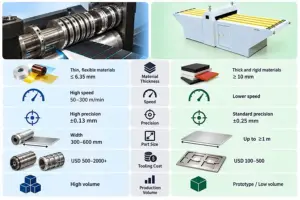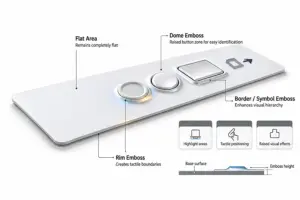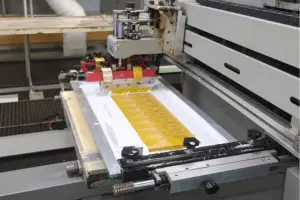
Polycarbonate (PC) and Polyester (PET) are common film materials for Graphic Overlays. Both can be Screen Printed, Die Cut, and Embossed to produce graphic markings, display windows, and button areas. In this article, iTrustFab compares PC and PET in terms of material properties, processing performance, and practical material selection.
1. Polycarbonate (PC) and Polyester (PET) in Graphic Overlays
Polycarbonate (PC) and Polyester (PET) are two common Polymer Films used for Graphic Overlays. Both materials can serve as the Overlay substrate.
1) Polycarbonate (PC) Film
Polycarbonate (PC) is a thermoplastic polymer film. Graphic Overlays typically use Graphic-Grade Polycarbonate Film.
Common PC Film thicknesses for Graphic Overlays include 0.125, 0.175, 0.25, 0.375, and 0.50 mm. Surface finishes include Gloss, Matte, Velvet, and Textured, while functional Film Grades include Hard-Coated, Anti-Glare, and UV-Resistant options.
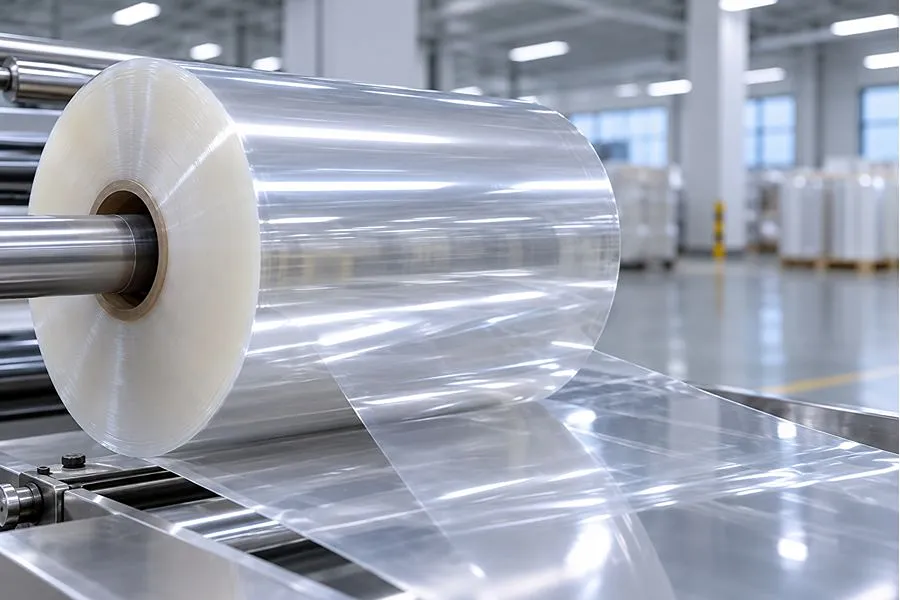
Graphic Overlay Polycarbonate (PC) Film
2) Polyester (PET) Film
Polyester Film is a film of Polyester. Usually, Graphic Overlays are made of PET (Polyethylene Terephthalate) Film.
Other common Film thicknesses include thinner gauges, 0.125, 0.175, 0.188 and 0.25 mm; surface finishes include Gloss, Matte, and Textured; and functional Film Grades include Hard-Coated, Chemical-Resistant, and Anti-Glare.
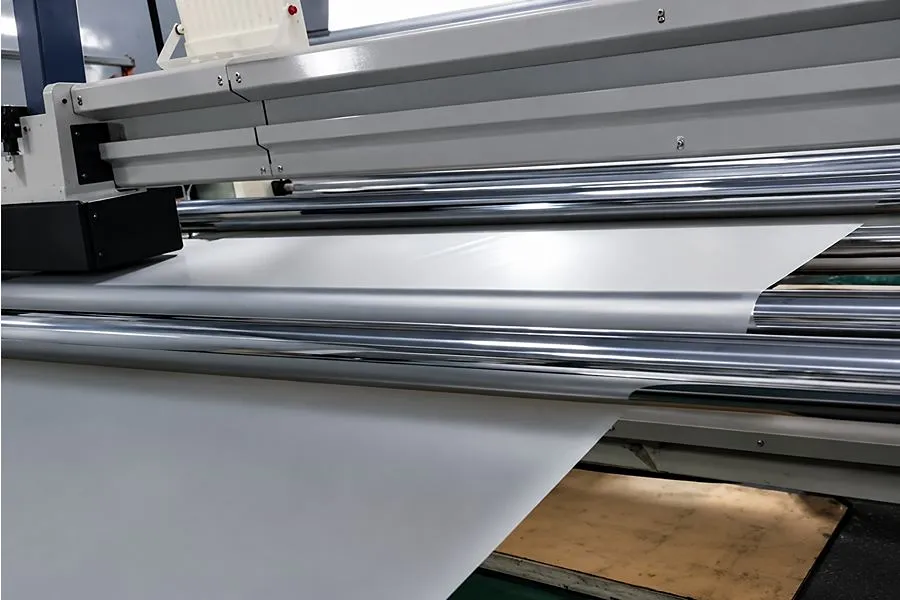
Graphic Overlay Polyester (PET) Film
2. Key Performance Differences Between Polycarbonate and Polyester
As Graphic Overlay substrates, PC and PET differ significantly in Flex Life, Chemical Resistance, Surface Durability, Optical Properties, and Thermal Stability.
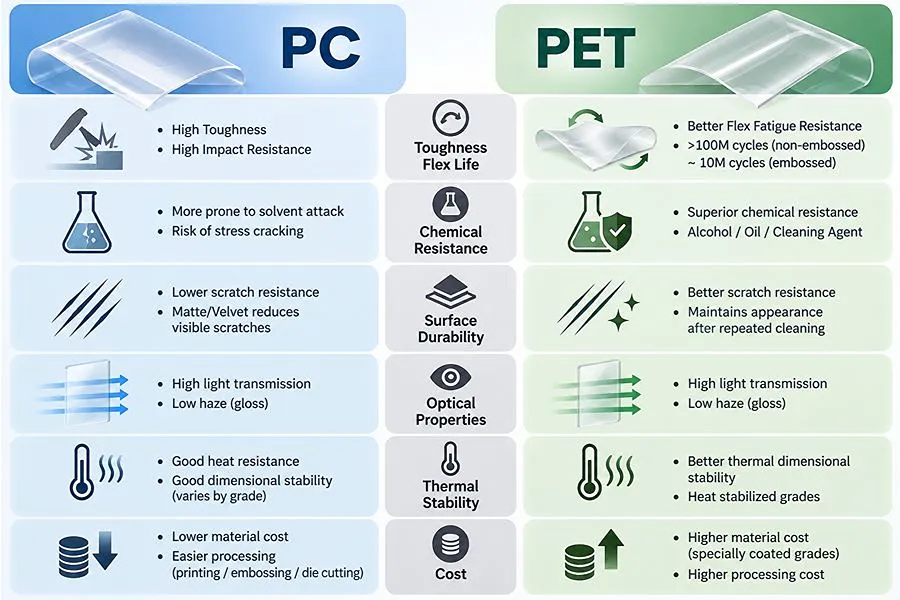
Key Performance Differences Between Polycarbonate and Polyester
1) Toughness, Flexibility, and Fatigue Life
PC has greater Toughness and Impact Resistance and is less susceptible to brittle fracture due to shock, local shock, or large deflection. PET has greater Flex Fatigue Resistance and is less susceptible to fatigue fractures due to flexing and pressing.
In a specific Graphic Overlay Actuation Test, non-embossed PET can exceed 100 million cycles. With Embossing, PET can achieve approximately 10 million cycles, while PC may be below 100,000 cycles. PET therefore has a clear advantage under repeated Flexing conditions.
2) Chemical Resistance
Overall, PET tends to be much more Chemical Resistant than the common PC, and more resistant to Alcohol, Oil, Cleaning Agents and many industrial chemicals. Some Solvents or Strong Cleaning Chemicals cause increased Chemical Stress Cracking, surface damage or performance degradation in PC.
3) Surface Wear and Scratch Resistance
Normal PET offers more scratch-resistant surface than normal PC. In case of the long-term use for the Graphic Overlay, there is an option to provide Hard Coat or Surface Texture for both surfaces. Main PET feature is the ability to remain in good surface condition after long friction and multiple times cleaning, while Velvet / Matte Texture for PC allows making fine scratches less visible.
4) Optical Properties
Both PC and PET are available as transparent Films for LCD, LED, and Display Windows. Both materials can provide high Light Transmission, and visual differences depend more on Film Grade and Surface Finish. Gloss surfaces generally have lower Haze, while Matte, Velvet, and Textured surfaces increase light scattering.
5) Temperature Resistance and Dimensional Stability
PET provides good thermal dimensional stability, especially Heat-Stabilized Film, which can reduce Shrinkage caused by printing, drying, and long-term temperature changes. PC itself provides good Heat Resistance and Dimensional Stability, although performance varies significantly among different Film Grades.
6) Cost Differences
For standard Graphic Overlay Grades, PC generally has a lower combined material and processing cost. PET, especially functional Films such as Hard-Coated and Chemical-Resistant grades, usually has a higher material cost. PC is generally easier to Print, Emboss, and Die Cut and has a wider processing window, so processing costs may also be lower for some projects.
Based on one set of 2025 North American distributor quotations for 0.175 mm Film, the material cost per unit area of PC was approximately 70%-85% of PET. However, Film is typically only part of the total Graphic Overlay cost and accounted for approximately 20%-35% of the finished-product cost in this cost model. Therefore, a raw-material price difference of approximately 15%-30% ultimately affected the Finished Overlay cost by approximately 4%-10%.
3. Processing Differences Between PC and PET
Processing performance directly affects Graphic Overlay production difficulty and batch consistency. The main processing differences between PC and PET involve Printing, Embossing, and Die Cutting.
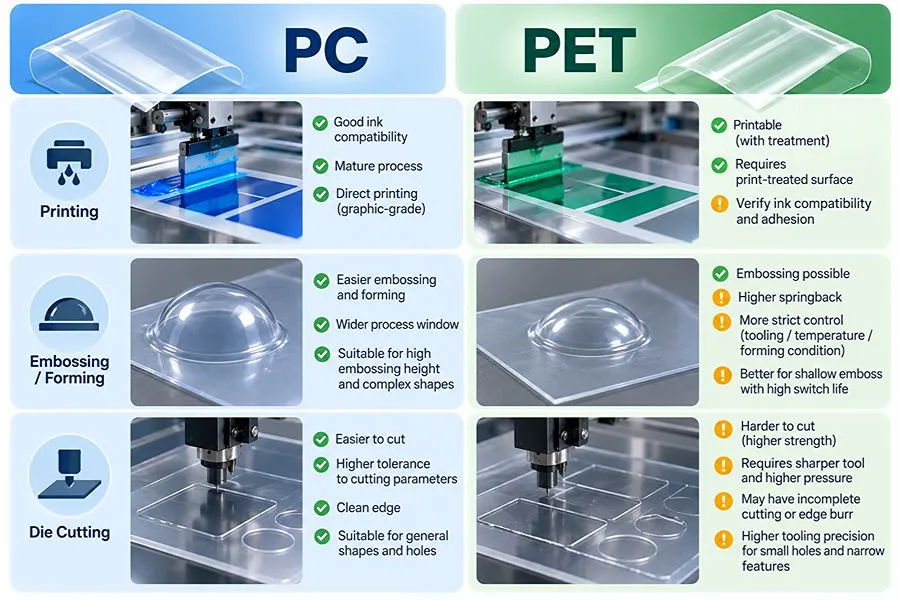
Processing Differences Between PC and PET
1) Printing Performance and Ink Adhesion
Both PC and PET can be Screen Printed and Digitally Printed. PC surfaces are generally compatible with Graphic Inks, and standard Graphic-Grade PC can be used directly with various Overlay Ink Systems. The printing process is relatively mature.
PET is more sensitive to surface energy and surface treatment in terms of Ink Adhesion. PET Film used for Graphic Overlays typically has a Print-Treated / Primer-Coated printing surface to improve ink adhesion stability. For untreated or insufficiently treated PET, Ink Compatibility and Adhesion should be confirmed before printing.
2) Embossing and Forming Performance
PC is more readily Emboss and Form than PET, and has a larger processing window. PC is more easily embossed to form raised structures like Pillow, Rim and Dome Embosses and can be embossed with higher Embossing Heights and complex geometries under the effect of heat and pressure.
PET may also be Embossed but with higher Embossing Height, Corner Radius and forming parameter sensitivity. For PET, there is also a need to control the Tooling, Temperature and Forming Conditions with precision to get a stable emboss height and shape at the same Film Thickness and Embossing Geometry.
PC tends to be easier to process when deeper or more complex forming is needed; PET can offer an advantage in the case of shallow Embossing combined with high Switch Life.
3) Die-Cutting Performance
Steel Rule Dies, Flatbed Die Cutting, Rotary Die Cutting, and Laser Cutting can be used to make outer profiles, windows and holes for both PC and PET. In comparison, PC is relatively easy to cut through and there is a greater tolerance of Die Cutting parameters, allowing for relatively simple processing of standard Graphic Overlay profiles and holes.
PET has a higher Tensile Strength and Tear Resistance so the cutting needs to be more controlled and the sharpness, height and Cutting Pressure needs to be controlled more tightly to be able to cut the PET completely. Insufficient pressure or worn tooling exposes PET to the risk of Incomplete Cutting, Edge Burrs or uncut local connections. In addition, small holes, narrow borders and dense features put higher demands on die accuracy and condition.
4. How to Choose PC or PET for a Graphic Overlay
Material selection can begin by identifying the equipment’s most critical failure risk: button fatigue, Chemical Exposure, surface wear, complex Embossing, or cost. Not every performance characteristic needs to be maximized.
1) When PC Is More Suitable
PC Graphic Overlay can be prioritized under the following conditions:
- Higher Embossing, complex button shapes, or other Forming Structures are required, placing higher demands on forming capability;
- The Overlay may be exposed to impact, localized shock, or large instantaneous deformation, requiring higher Toughness and Impact Resistance;
- Button operating frequency is relatively low, with no particularly high Flex Life requirement;
- The service environment does not involve frequent Chemical Exposure, and material and processing costs need to be controlled;
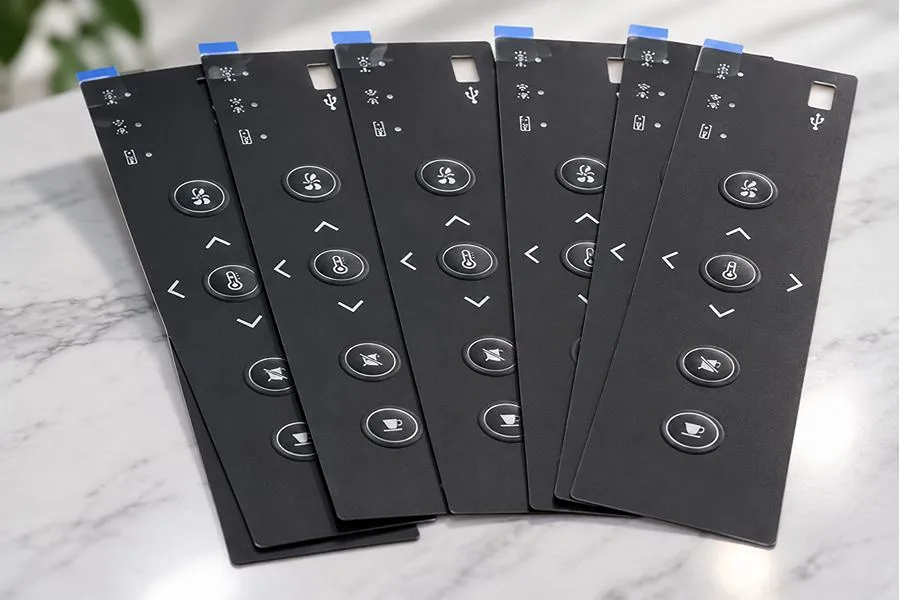
Finished PC Graphic Overlay
2) When PET Is More Suitable
PET Graphic Overlay can be prioritized under the following conditions:
- Membrane Switch buttons need to undergo repeated actuations which demands greater Flex Fatigue Life;
- The equipment must be wiped regularly with Alcohol, Cleaning Agents or Disinfectants or long-term contact with Oil and other Chemical Media;
- The Overlay surface must have more Surface Durability since it is to be used continually, is subject to friction and/or repeated cleaning;
- Increased dimensional stability following temperature change is needed; Heat-Stabilized PET Film can be chosen.
- The product must have more durability over time: Hard-Coated, Chemical-Resistant or Heat-Stabilized PET Film could be used depending on the requirements.
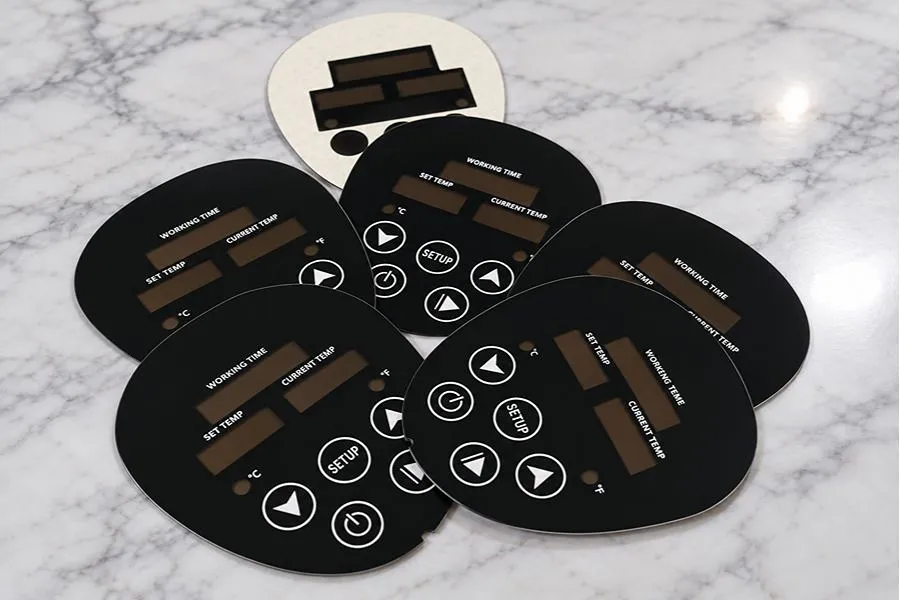
Finished PET Graphic Overlay
5. Conclusion
There are two methods available for Graphic Overlays, PC and PET, both having different requirements. The benefits of PET are Flex Life, Chemical Resistance and long-term wear resistance, whereas the benefits of PC are Formability, Embossing and cost.
iTrustFab can decide what type of PC or PET Film is suitable for you according to the Drawing, the structure of buttons, the operating frequency, the cleaning, and the working environment, and can print, emboss, laminate with adhesive and cut precisely. Please reach out to us for assistance.